
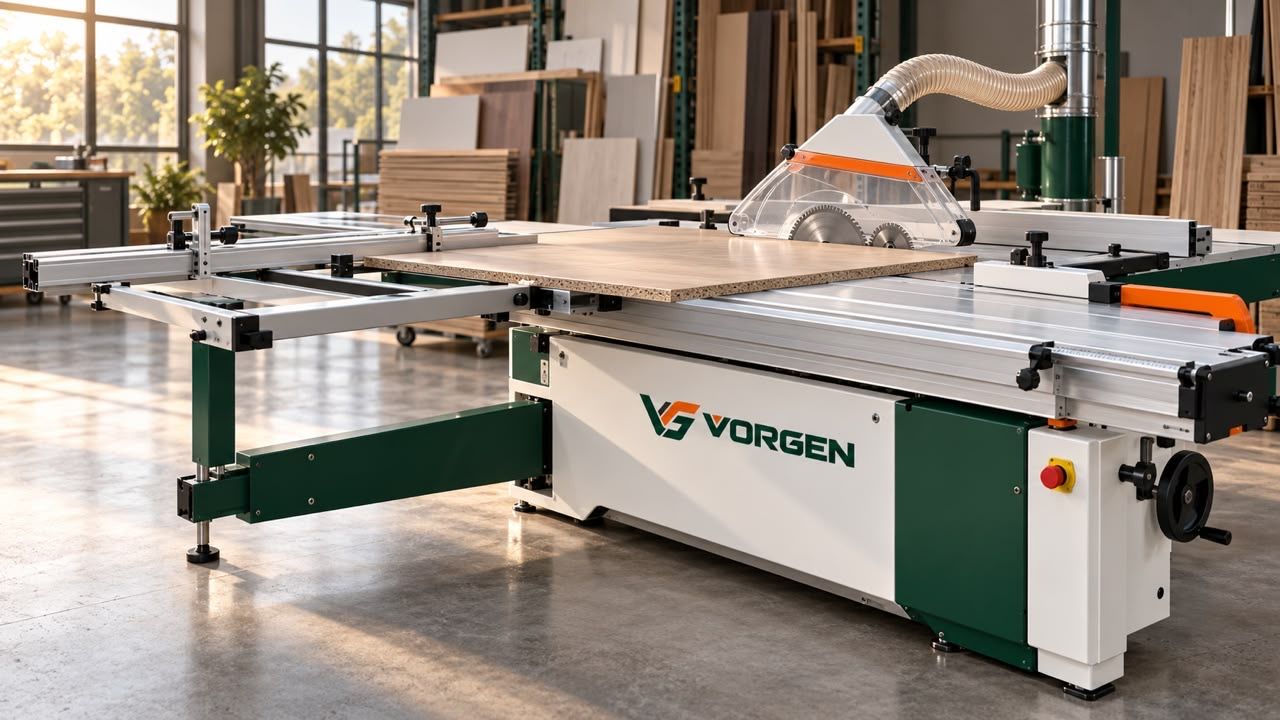
Sliding Table Saw Guide
VORGEN Education · 01 · Entry / Start

Sliding Table Saw Guide

The first machine most workshops own — and the one most often set up wrong.

Safe, accurate, repeatable panel cutting. Starts with kickback and guarding, then moves through scoring, blade choice, calibration and the cut quality that decides everything downstream.

Watch
Understand
Apply
Grow
Who it is for
  • New operators on their first panel saw
  • Workshops setting up an Entry-stage workshop
  • Anyone whose panels are coming out out-of-square
Before you start
  • No previous machine experience required
  • Safety module must be completed before operating
What you will be able to do
  • Work safely around a running saw and explain how kickback happens
  • Set the scoring blade for chip-free cuts in melamine
  • Calibrate blade, fence and slide, and verify with a five-cut test
  • Break down a full sheet in a sensible, repeatable sequence
  • Batch-cut parts to matching dimensions
Where it fits

This course belongs to 01 · Entry / Start of the VORGEN journey.

See the stage →
Syllabus

10 modules.

Draft course outline for confirmation. Module order and depth to be finalised with the training team.

01

Safety before anything else

  • How kickback happens and the body positions that avoid it
  • Riving knife and guard: what each protects against
  • Push sticks, hold-downs and safe hand placement
  • Personal protective equipment, and the clothing and jewellery rules
  • What to do when something binds mid-cut
02

Machine anatomy

  • Sliding carriage, main blade, scoring blade
  • Rip fence, crosscut fence, outrigger table and flip stops
  • Rise, fall and tilt controls
  • Dust extraction connections above and below the table
03

The scoring blade

  • Why melamine chips on the underside without one
  • Setting scoring depth and width relative to the main blade
  • Aligning the scorer, and the symptoms of misalignment
  • When the scorer is not needed
04

Blade selection

  • Tooth count and what it does to feed rate and finish
  • Grind types and matching them to melamine, solid wood or laminate
  • Kerf width and its effect on your cutting list
  • Recognising a blunt blade before it burns a panel
05

Calibration

  • Blade parallel to the sliding table
  • Squaring the crosscut fence
  • Rip fence alignment and why a slight toe-out is deliberate
  • The five-cut test: measuring and correcting real error
06

Breaking down a sheet

  • Planning cuts from a cutting list before touching the saw
  • Reference edges and keeping track of them
  • Cutting oversize then to final dimension, and when that is worth it
  • Handling full sheets safely, alone and with help
07

Repeatable and batch cutting

  • Using stops instead of measuring every part
  • Cutting all like-sized parts together
  • Labelling parts as they come off the saw
  • Cumulative error and how to avoid it
08

Cut quality

  • Feed rate, blade height and their effect on the edge
  • Chipping on the top face versus the bottom face
  • Burn marks and what they indicate
  • Checking squareness and diagonal on a finished panel
09

Maintenance

  • Cleaning resin and adhesive from blades
  • Sliding table cleanliness and movement
  • Routine alignment checks and how often to do them
  • Dust extraction performance and its effect on cut quality
10

Knowing when you have outgrown it

  • Signs the saw has become the bottleneck
  • Labour per panel compared with a nesting workflow
  • What to fix in process before buying a bigger machine
  • How this stage prepares you for Intermediate and Advanced